
The Ever-Shifting Sands of Programming Languages in 2025
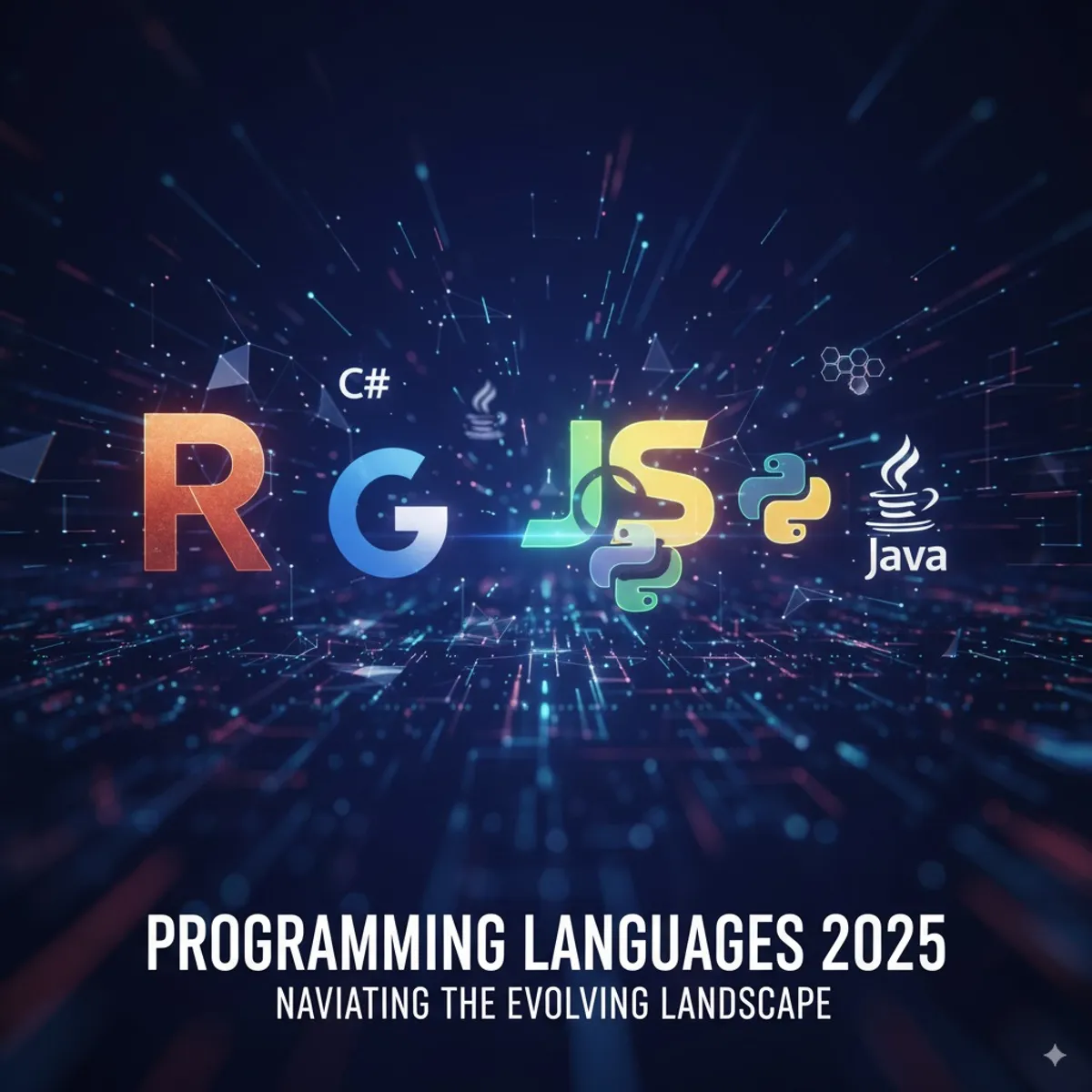
The world of programming languages is in a constant state of flux. Every year brings new contenders, evolving paradigms, and shifts in industry preference. In 2025, we observe a dynamic landscape shaped by the demands of AI, performance, security, and developer productivity.
The Enduring Titans and Their Evolution
Some languages continue to hold their ground, adapting and expanding their ecosystems to meet modern requirements.
- Python: Still the undisputed king of Data Science, Machine Learning, and AI. Its simplicity, vast libraries, and strong community ensure its dominance, with performance enhancements continuously being integrated.
- JavaScript/TypeScript: The backbone of the web. TypeScript’s type safety has become a standard for large-scale web projects, extending its reach from front-end to back-end (Node.js) and even mobile (React Native).
- Java/C#: Enterprise workhorses. Both continue to evolve with new features, performance improvements, and broader platform support (e.g., GraalVM for Java, .NET 8/9 for C#) remaining highly relevant for large-scale, robust applications.
Tip (Performance Focus)
For established languages like Python and JavaScript, efforts to enhance raw performance (e.g., CPython optimizations, WebAssembly integration) are key trends, allowing them to tackle more computationally intensive tasks.
Rising Stars and Niche Dominators
Beyond the titans, several languages are cementing their places or rapidly gaining traction.
- Rust: The darling of systems programming. Rust’s unparalleled memory safety guarantees without a garbage collector, combined with its performance, makes it ideal for operating systems, game engines, and critical infrastructure. Its learning curve remains steep, but the benefits are undeniable.
- Go (Golang): Excelling in cloud-native development and microservices. Go’s simplicity, concurrency model, and efficient compilation to single binaries make it a preferred choice for building scalable backend services.
- Kotlin: A strong alternative to Java for Android and backend development, offering conciseness and modern language features that improve developer experience.
- Swift: Dominant in Apple’s ecosystem, continuing to evolve for both application development and emerging areas like server-side Swift.
Important (The Appeal of Safety and Performance)
Languages like Rust are gaining significant traction because they offer a powerful combination of memory safety (preventing common bugs and security vulnerabilities) and high performance, which is increasingly critical for complex software.
Emerging and Experimental Languages
The future is always being forged, and several newer or experimental languages are worth watching.
- Carbon: Google’s experimental successor to C++. Aiming for interoperability with C++ while offering modern language features, better tooling, and faster compilation. It’s an ambitious project with the potential to reshape high-performance computing.
- Zig: A low-level systems programming language designed for robustness, optimality, and maintaining explicit control. It’s carving a niche among developers who need fine-grained control over hardware.
- Julia: Gaining significant ground in scientific computing and numerical analysis, offering a sweet spot between Python’s ease of use and C’s speed.
Key Trends Shaping Language Development
Several overarching trends are influencing the design and adoption of programming languages in 2025.
Note (AI-Assisted Coding)
The rise of AI-powered coding assistants (like GitHub Copilot and similar tools) is transforming the developer workflow, making code generation and auto-completion more sophisticated. This allows developers to focus more on architecture and less on boilerplate.
- Developer Experience (DX): Languages are increasingly designed with developer happiness in mind, focusing on clear syntax, powerful tooling, and helpful error messages.
- Concurrency and Parallelism: With multi-core processors being the norm, languages with robust and intuitive concurrency models (like Go’s goroutines or Rust’s async/await) are highly valued.
- Security by Design: Preventing common vulnerabilities through language features (e.g., Rust’s borrow checker) is a growing priority.
- Interoperability: The ability for languages to easily interact with code written in other languages is crucial in a polyglot development environment.
- Domain-Specific Languages (DSLs): While not general-purpose, the creation of highly specialized DSLs within larger frameworks (e.g., for infrastructure as code, declarative UI) continues to grow.
Conclusion
The programming language landscape in 2025 is a vibrant ecosystem. While established languages continue to evolve, newer entrants like Rust and Go are proving their worth in critical domains, and experimental languages like Carbon hint at future directions. For developers, continuous learning and understanding the strengths and weaknesses of various languages for specific problem domains remain paramount. The best language is often the one best suited for the task at hand, with the most productive tooling and community support.
Recommended for You
Explore more articles on similar topics and continue reading.